Galcon Games
Phil Hassey - game dev blog
Phil Hassey as Syndrome
"Look, stores don't sell
costumes like this to just anyone."

Archive for the 'python' Category

New Year’s Python meme

Monday, January 4th, 2010
Hmmn, better late than never, ‘eh?
  1. What’s the coolest Python application, framework or library you have discovered in 2009 ?
    pygame – I’ve used it for ages, but I rediscovered it this year for a new use.  Now-a-days I use it for processing images (creating batches of icons, creating texture atlases, etc)
  2. What new programming technique did you learn in 2009?
    I’ve used databases for _ages_ in web development.  This year a friend suggested I could use databases to store data for games and 1. avoid recompiling 2. avoid parsing 3. use a nice database frontend to manage it.  I’ve only experimented with it briefly, but it seems like a pretty keen technique :)
  3. What’s the name of the open source project you contributed the most in 2009? What did you do?
    I was a bit of an open-source waste-of-space this year.  But in the last two weeks of the year I began doing work on my tinypyC++ converter.  So far I’ve used it to put one game on the App Store.
  4. What was the Python blog or website you read the most in 2009?
    Planet Python.  Thanks everyone :)
  5. What are the three top things you want to learn in 2010 ?
    How to do game PR.  How to present at conferences.  How to not go crazy.

Over the course of 2009 I used python much less than in 2005-2008.  This year (with the help of tinypyC++) I hope to be using (something like) python again.  C++ just isn’t nearly as fun!  I don’t plan on attending PyCon this year, though I wish I could.  There’s just a limit to how many conferences I can attend.  If anyone is at GDC, catch up with me!  I’ll be speaking at the iPhone Summit about multi-player network testing.  I always gotta thank the python community for introducing me to the magic of testing.  It’s what makes network code and mad projects like tinypy possible.

-Phil

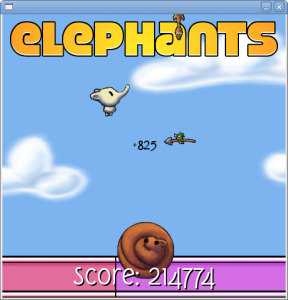
Elephants! is free on the App Store!

Wednesday, December 23rd, 2009

My gift to you: A totally FREE iPhone game! I made this game several years ago with some other way-cool game-dev friends. In “Elephants!” you save the giraffes while jumping on a rolled up squirrel! More fun than a barrel of pigeons! For Christmas this year I figured I’d port it over to the iPhone for you :) Check it out!

From the dev side, yeah, this is my first attempt at “python” on the iPhone. Even though it’s actually restricted tinypy code. Here’s a sample of game code so you get the idea of what’s behind this game. All this code is converted by tinypy into C++ code so I can compile it with Xcode for the iPhone:

def elephant_new(g:Level,pos:List(int))->Sprite:
    s = Sprite('elephant',pygame.Rect(43-14,8,28,48))
    s.rect.set_centerx(pos[0])
    s.rect.set_bottom(pos[1])

    g.sprites.append(s)

    s.ball = ball_new(g,(int(s.rect.get_centerx()),int(s.rect.get_bottom())))
    s.suit = ElephantSuit()
    s.vy = 0
    s.vx = 0
    s.jump = 0
    s.facing = 'e'
    s.score = 0
    s.z = 1
    s.state = 'live'
    s.name = 'elephant'

    return s

Elephants! First python + pygame game submitted to App Store :)

Saturday, December 19th, 2009

So, I managed to submit a “python” app to the App Store — “Elephants!” Here’s a few crazy things I had to work out to get things going:

  • I found that ObjC doesn’t care much for C++ objects that do their own reference counting.  To have a “Game” object at all, I had to use a pointer to my object instead of using my reference counting object.  It seems that during some of the “magic” of ObjC it copies objects without calling any of the C++ copying methods, so reference counting gets killed.
  • I ported a basic subset of pygame to tinypyC++ and made it work under openGL.  I don’t have this available in my tinypyC++ repository because it takes a good deal of prep-work to use (isn’t out-of-the-box) so it wouldn’t be generally useful to anyone yet.
  • I was able to get pause on call / resume working by saving the game state to a text file.  Since tab-separated files are so easy to create and parse in python this seemed to be the easiest route to getting the project done.
  • I learned a ton about C++ templates.  I still haven’t even touched the tip of the iceberg, and I’m not sure I want to, but at least I’m getting the basics down and that seems to be enough for me to stumble through this project with.

You can check out my current progress at svn://www.imitationpickles.org/tinypy/branches/tinypy2 (in the tinypy/example folder you can check out a julia fractal demo.  It also includes a mini pygame module that depends on SDL not OpenGL, so it actually works out-of-the-box.)

Here are some things I’ve been adding this week in preparation for my next project:

  • I’ve added “weak pointers” .. Since reference counting has the problem of cyclic references never getting collected, I had to do this for some use-cases.  In tinypyC++ weak pointers are just normal pointers, and if the object is collected, the pointer will be invalid, so be careful.  They are created by doing stuff like “x = ptr(GameData())”
  • I’ve added more C style types.  I’ve got uint16, cstr, Array, etc.  This all makes it possible for me to have a different kind of object – a struct in tinypyC++.  The struct is meant to be a C oriented type that can be saved directly to disk.  In Elephants I serialized via saving CSV data.  In the future, if I keep all the game state in C struct type data, I can just use a single simple line like “open(‘data.txt’,'wb’).write(struct_dump(game_data)”
  • I found that STL extensions include a “hash_map” which turns out to be about 2x as fast as the normal “map”.  I’m using that now.

I’m not entirely sure how useful this project is going to be for anyone else, or even for me for that matter.  But I think after my next game project I’ll have a much better feel for what the situation is.  TinypyC++ has some real tradeoffs in terms of being a bit of a hybrid of C++ and of python.  It doesn’t offer the full power of either language.  But I’m doing my best to capture a middle ground between them that will make my life easier.

Restricted tinypy to C++ compiler

Tuesday, December 1st, 2009

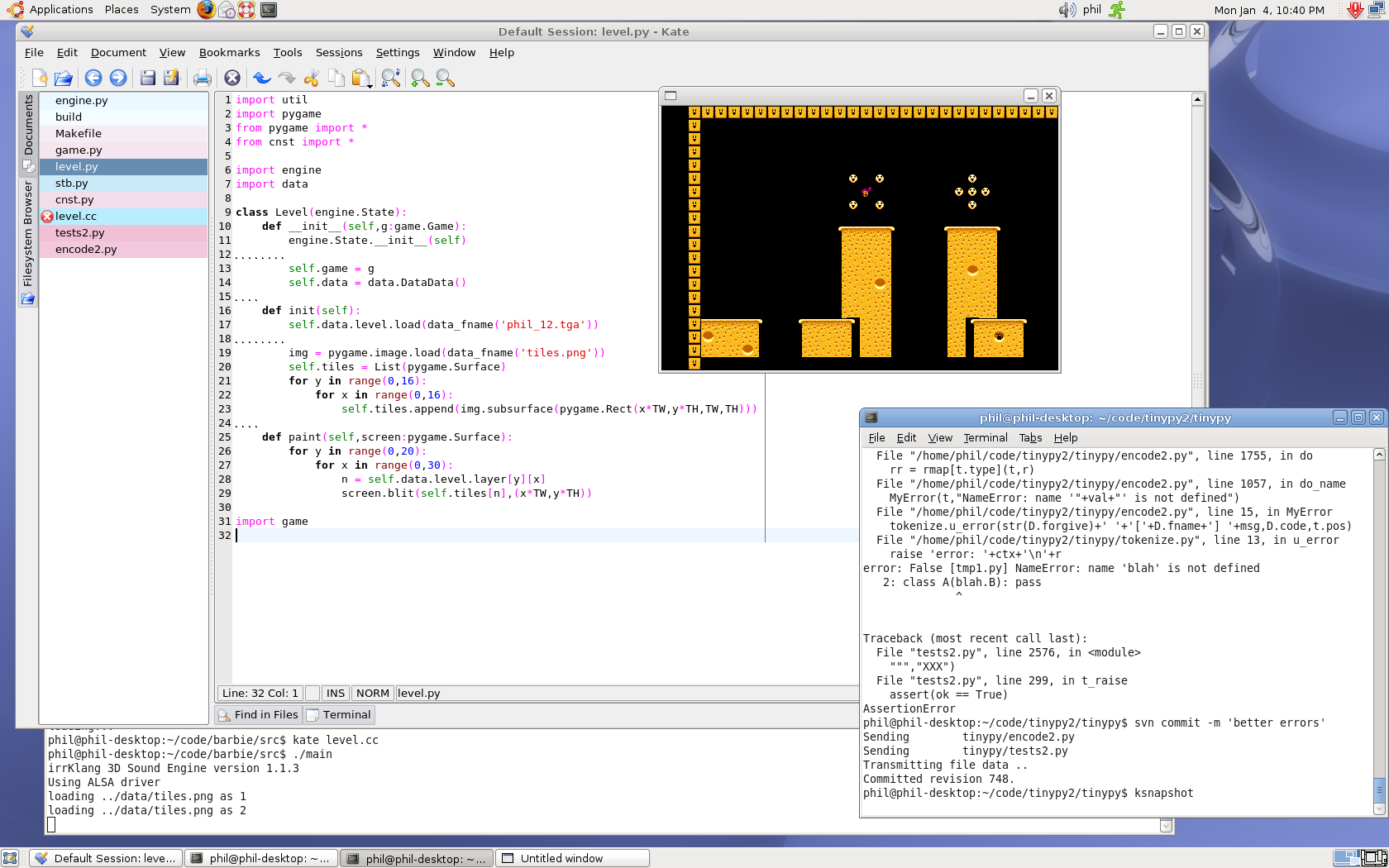
elephant1I’ve spent the last week working on a tinypy to C++ converter.  It works!  See the screenshot to the right – I’ve managed to port a pygame game over to C++.
Here’s how (and some of the catches):

  • I require type annotation of all the functions and methods.  ”def test(x:str)->str: return x”
  • I do two passes on each file, the first pass to catch all the function types and class members, and the second pass to generate the code.
  • I generate C++ code that has automagic reference counting.  So you have to code your script so it won’t have any cyclic references if you want garbage collected for you.

How is this different from shedskin (really cool project!)?

  • Built-in reference counting, instead of using libgc.
  • I require the user to type annotate everything.
  • It only supports a subset of the tinypy subset of python.  Shedskin supports a much larger subset of python.

So what’s the point?

  • Well, I learned a lot about STL and C++.
  • I know it will produce iPhone friendly code, I’m pretty sure libgc isn’t iPhone friendly?  (At least, I haven’t found anything via a few searches…)
  • Way less magic.  Since everything is annotated, there are no surprises.
  • Implementing C++ modules is pretty easy – the code can be inlined within the python code and it just works.
  • This will make it easier for me to develop C++ games.

Anyway, if you’re super brave, you can check out svn://www.imitationpickles.org/tinypy/branches/tinypy2 .. I don’t have the elephants example in there, but the pygame.py that I include gives you a pretty good example of a complex module.

I’m going to chat with the tinypy folks to see if we’ll merge this into the tinypy trunk or have it as a separate project.  I’m not quite sure what makes sense to everyone else :)  The nice bit about merging this in is that I could unify the test suites nicely.  And tinypy would still function as normal, just better tested, and with function annotation parsing supported.  All that said, I should make a tinypy module for tinypyC++ so that I can do some code evals!

Galcon Labs on the App Store!

Friday, October 2nd, 2009

Hey,

So Galcon Labs is now available on the App Store! Check it out :)

Anyway, I just got back from 360iDev where I gave a talk about Galcon Multiplayer.  The two main points made in the talk were about managing community, and test driven development.  With so many devs talking about App rejections and other problems, I wanted to make sure the app was approved first time through the system.  And it was, in an excellent 7 day turn-around :)  So a real big thanks to all the folks out there who pressed me into reading the Kent Beck book on the subject!

-Phil

Galcon Labs – Preview!

Thursday, September 24th, 2009

labs-asn-1-p-txtHey,

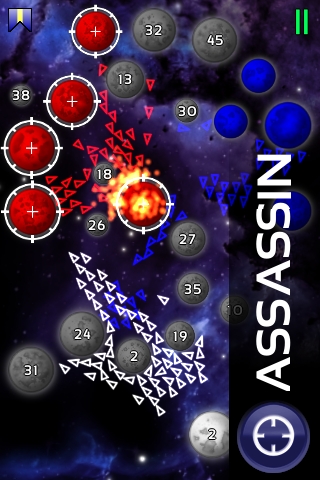
After a few days of itunesconnect being down, I was able to submit Galcon Labs to the App Store.  Check it out!  (See Phil’s first ever video!)

On a dev note, this game was REALLY fun to make.  I got to do things that completely change the gameplay of Galcon so that Galcon Labs is really four totally different feeling games.  My favorites are the Billiards mode (where the planets move around) which is just a lot of fun, and the Assassin mode where instead of trying to conquer everyone, you are assigned a single player that you have to destroy first.  The interesting thing about that, is if you destroy another player, or the player who is trying to annihilate you gets destroyed – YOU LOSE!  It really changes up how you have to play!

As usual, testing (TDD) was a big deal.  Having a network game makes it so that everything has to be tested to make sure it really works.  I’m going to be doing a talk at 360iDev on Wednesday, so if you want to hear me compare UDP networking to herds of rabid animals, be sure to attend.

Also, check out pygame 1.8.  It is really awesome :)  While working on Galcon Labs I felt I needed to put more effort into differentiating the game from previous Galcon games visually.  As it’s still triangle ships and planets, this took some effort.  And during the last hour, I decided I needed a whole shiny new look for the planets.  In the game I use a texture with 64 planet designs on it.  So creating all those by hand would have been too hard.  I used pygame to generate new landscapes and found the new pygame 1.8 features really helpful.  I was able to use the new blending modes to trim the landscapes into circles and rotate and scale them down so I got a nice antialiased look for all the planets.  In previous versions of pygame, this would not have been nearly as easy!  So, not just for games, but for generating and doing automated image manipulation, pygame is really starting to shine :)

Cheers!
-Phil

Oddball python import issue?

Thursday, July 16th, 2009

It seems when I have the import within my function I get some strange behavior.  For lack of cooperative blog formatting, here’s a link to the code and the results.  I tested this with python 2.5.2 and 2.6.2.

Now that I’ve pinpointed the issue I can easily work around it.  But .. I’m still curious if anyone can tell me what is going on?  Is this a feature?  Or is there a bug at work here?

Galcon at 360iDev

Monday, July 13th, 2009

“I just got accepted to speak at the 360iDev Conference!  The show will be going down September 27 to 30, 2009.  It’s looking like it’s gonna be a great show, especially with yours truly speaking. The first one was a hit among the attendees and this one is looking even better than the last. Tickets are cheaper on a first come, first serve basis! So buy your tickets asap at http://www.360idev.com/ to get the best possible price. See you there and you better go to my session!”

So, yeah, .. It should be awesome.  I managed to secure an 80 minute talk spot – which will include me talking about dev, Nan talking about the community, and Tim talking about the audio.  So it’s really going to be a great opportunity to meet the whole Galcon team.

Cheers!

-Phil

Galcon Flash has arrived ..

Tuesday, June 23rd, 2009

So .. Yeah.  Check it out.  Realtime multi-player game .. in flash!

So on a more technical note .. The game involves quite a number of technologies!

  • AS3 – of course – for the Flash client itself
  • C++ – for the server
  • PHP – for the web API and rankings system
  • python – for the bots

If I did the project over, I’d probably do the server in python as well.  But all in all the project went pretty well.  After things were done, it only took me a morning to write up the python client.  There’s a very good chance I’ll release that code in a few weeks and let people try making bots for the game.

Anyway – have fun checking it out.  I’m a bit wiped out from wrapping all this up, so I’ll try and post some more interesting details later!

-Phil

I can has flash?!

Thursday, March 12th, 2009

So .. who thinks flash + Galcon = win?  I don’t know yet, but I’m giving it a try.  I’m not actually developing the flash version.  An awesome friend of mine has been doing the time on this one.  Though I’ll probably be doing the LAMP end of the deal.  At present the game is non-networked, but we’re been considering the possibilities.  A TCP/IP edition of the game could be made, but I wonder if that would end in tears.  TCP/IP isn’t ideal for gamedev IMO.  Flash doesn’t support UDP as-of-yet.

This isn’t the first time Galcon has reared it’s head from within the browser window.  (See my earlier blog posts …)

I haven’t decided exactly what I’m going to do with this once it’s completed.  Probably a few things.  Throwing it on facebook is an obvious one.  Throwing it on galcon.com is another one.  Maybe mixing it with something like The Maze of Madness is another one.  Or maybe something else!

One idea that I have that would be really cool would be if the tinypy vm were ported to ActionScript using Alchemy* .. and then somehow people would be able to script Galcon on the web and share it with their friends..

*I don’t know if you caught that .. but I think my weekend just got booked :)


Galcon   Watermelons   Dynamite   The Hairy Chestival
All content of imitation pickles (c) 1999-2008 - Phil Hassey  "we care"